


Prepare your certificates for the 47-day future with automated certificate management
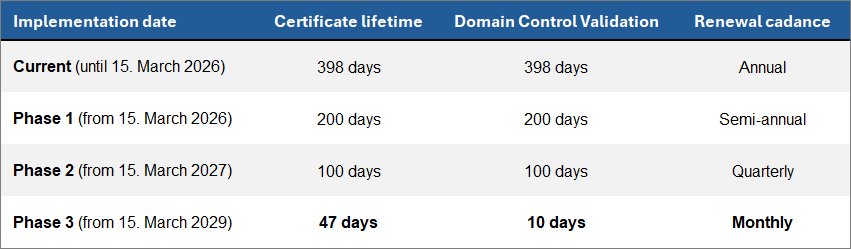
TLS certificate lifetimes are officially shrinking from 398 days to just 47 days by 15. March 2029, making automated certificate management not just a convenience but an absolute necessity.
Organizations that don’t embrace automation will face operational chaos, security risks, and inevitable outages.
The solution?
Certificate renewal automation using Automated Certificate Management Environment (ACME) – your gateway to seamless, bulletproof certificate management in the new era.
Understanding the new certificate landscape
The digital security world are facing a seismic shift. The CA/Browser Forum has officially voted to amend the TLS Baseline Requirements, setting an schedule for shortening the lifetime of TLS certificates and how often the embeded CA-verified information can be reused from the curent 398 days to only 47 days.
This isn’t a distant proposal – it’s a done deal with a clearly defined timeline that will reshape how every organization manages its digital certificates.
The new timeline: Mark your calendars
Here is the phased rollout plan that every organization and IT team needs to prepare for:
Why this change really matters
Service-oriented environments are particularly vulnerable to certificate-related disruptions. With an ecosystem of digital services, APIs, and containerization depending on certificates, the complexity multiplies exponentially. Research shows that a large portion of organizations experienced at least one certificate-related outage in the last year, with a third suffering multiple outages.
In modern environments, a single expired certificate can cascade through multiple services, creating a domino effect of failures. With the shorter certificate lifespans, this risk increases exponentially.
The Automation imperative: Why manual certificate management is dead
Let’s do the math that will keep you up at night – or motivate you to automate everything.
Consider an organization managing just 50 certificates. By 2029, managing the same certificate inventory will result in more than 400 renewal events each year. When each renewal takes even one hour, the cumulative labor quickly becomes unmanageable – and if the inventory include 5000 certificates the accumulated hours equates to over 4,5 years of work!
Add on top of this the staggering effect on change management, tracking of endpoints, the risk from the human factor from forgotten renewal dates and misconfigurations, as well as the potential cost from compliance violations and audit failures.
Enter ACME – Automated Certificate Management
The Automatic Certificate Management Environment (ACME) protocol is a communications protocol for automating interactions between certificate authorities and their users’ servers, allowing the automated deployment of public key infrastructure at very low cost.
Understanding ACME: Beyond the basics
ACME isn’t just another protocol – it’s a paradigm shift that transforms certificate management from a manual, error-prone process into a seamless, automated operation. Originally designed by the Internet Security Research Group (ISRG) for their Let’s Encrypt service, the protocol has been published as an Internet Standard in RFC 8555.
The ACME advantage: Why It’s perfect for the 47-day certificate lifecycle
1. Complete Automation
ACME automates certificate issuance and renewal, improves website security, reduces human error in certificate management, and is widely supported by certificate authorities and web servers. In the 47-day world, this isn’t a luxury – it’s survival.
2. Standardized Process
The protocol provides a standardized approach that works across different Certificate Authorities and platforms, ensuring consistency in your operational environment regardless of your infrastructure complexity.
3. Scalability
ACME offers organizations seamless certificate management automation with comprehensive administration capabilities for publicly trusted and non-public DV and OV certificates, making it perfect for complex, multi-service architectures.
4. Cost Efficiency
Reduce costs by eliminating the need for internal PKI expertise, ongoing maintenance, and associated costs while increasing volume and velocity of certificate issuance and renewal.
How ACME works: The technical magic explained
The ACME Workflow: Step by Step
- Account Creation: The ACME client establishes an account with the Certificate Authority (CA)
- Certificate Request: The client requests a certificate for specific domain(s)
- Domain Validation: The CA challenges the client to prove domain ownership
- Challenge Completion: The client automatically responds to validation challenges
- Certificate Issuance: Upon successful validation, the CA issues the certificate
- Automatic Installation: The certificate is automatically deployed to your infrastructure
- Lifecycle Management: Renewals happen automatically before expiration
Challenge types: Proving that you own the domain
ACME supports multiple validation methods:
HTTP-01 Challenge
- Places a specific file on your web server
- CA verifies the file via HTTP request
- Perfect for standard web servers
DNS-01 Challenge
- Adds a specific DNS TXT record to your domain
- Ideal for wildcard certificates and internal services
- Works even when HTTP isn’t available
TLS-ALPN-01 Challenge
- Uses TLS Application-Layer Protocol Negotiation
- Suitable for environments where HTTP/DNS challenges aren’t feasible
Implementation Strategies
Planning Your ACME migration
Phase 1: Assessment and Preparation
- Audit your current certificate inventory
- Identify all services and endpoints requiring certificates
- Map certificate dependencies across your digital landscape
- Select appropriate ACME clients for different platform types
Phase 2: Pilot Implementation
- Start with non-critical services
- Implement monitoring and alerting
- Test renewal processes thoroughly
- Document procedures and troubleshooting guides
Phase 3: Production Rollout
- Gradually migrate critical services
- Implement redundancy and fallback procedures
- Train operations teams on the new processes
- Establish governance and compliance frameworks
Security benefits: More than just automation
Reduced Attack Surface
Shorter lifespans mean less time for compromised certificates to be exploited, improving security posture through frequent renewals that ensure certificates use the latest standards and configurations.
This is also a method for shorten the exposure of certificates to the emerging quantum computing capabilities, and the threat from real-time decryption lurking in the horizon of this decade.
Enhanced crypto-agility
The frequent renewal cycle makes it easier to:
- Deploy updated cryptographic algorithms
- Respond quickly to security vulnerabilities
- Maintain compliance with evolving security standards
- Prepare for quantum computing threats
Improved incident response
Automated certificate management provides:
- Real-time visibility into certificate status
- Automatic remediation of expiring certificates
- Consistent security policies across all endpoints
- Detailed audit trails for compliance requirements
Overcoming common implementation challenges
Challenge 1: Legacy system integration
Problem: Older systems may not support ACME natively
Solution: Use ACME proxies or certificate deployment automation tools to bridge the gap
Challenge 2: Network segmentation
Problem: ACME challenges may fail in highly segmented networks
Solution: Implement DNS-01 challenges or use ACME servers accessible from segmented networks
Challenge 3: Organizational Change Management
Problem: Teams resistant to automation
Solution: Start with training, demonstrate benefits through pilot programs, and provide robust documentation
Challenge 4: Compliance and Governance
Problem: Automated processes may conflict with existing approval workflows
Solution: Implement automated approval pipelines with appropriate oversight and audit capabilities
Building your ACME-enabled future
Essential components for success
Monitoring and Alerting
- Real-time certificate status monitoring
- Early warning systems for renewal failures
- Integration with existing monitoring infrastructure
- Comprehensive dashboards for operational visibility
Documentation and Training
- Detailed runbooks for common scenarios
- Emergency procedures for automation failures
- Regular training updates as processes evolve
- Cross-team knowledge sharing initiatives
Governance Framework
- Automated policy enforcement
- Regular security audits
- Compliance reporting automation
- Change management procedures
Measuring success
Key performance indicators for your ACME implementation:
Operational Metrics
- Reduction in manual certificate management tasks
- Decrease in certificate-related outages
- Improved mean time to recovery (MTTR) for certificate issues
- Cost savings from reduced manual effort
Security Metrics
- Elimination of expired certificates in production
- Consistent application of security policies
- Reduced time to deploy security updates
- Improved audit compliance scores
Business Metrics
- Reduced downtime costs
- Improved service reliability scores
- Enhanced customer trust and satisfaction
- Accelerated deployment of new services
Looking ahead: The post-47-day world
The transition to 47-day certificate lifetimes represents more than just a technical change – it’s a fundamental shift toward a more secure, automated, and resilient internet infrastructure.
Organizations that embrace this change early will gain significant competitive advantages:
Strategic benefits
Operational Excellence
- Streamlined certificate management processes
- Reduced operational overhead
- Improved service reliability
- Enhanced security posture
Innovation enablement
- Faster deployment of new services
- Reduced barriers to adopting HTTPS
- Improved developer productivity
- Enhanced automation capabilities
Future-proofing
- Preparation for even shorter certificate lifespans
- Ready for quantum-resistant cryptography
- Alignment with industry best practices
- Competitive advantage in security-conscious markets
Taking action: Your next steps
The clock is ticking, but you have time to prepare.
Here’s your roadmap to success:
Immediate actions (30 days)
- Assess your current certificate inventory
- Catalog all certificates in use
- Identify renewal patterns and dependencies
- Evaluate current management processes
- Begin education and planning
- Train your team on ACME concepts
- Research appropriate tools and vendors
- Develop a migration timeline
Short-term goals (3-6 months)
- Implement pilot programs
- Select low-risk services for initial ACME deployment
- Test automation workflows
- Validate monitoring and alerting systems
- Establish governance frameworks
- Define policies for automated certificate management
- Create approval processes for production deployment
- Develop incident response procedures
Long-term strategy (6+ months)
- Scale automation across your environment
- Migrate critical services to ACME management
- Implement comprehensive monitoring
- Optimize processes based on lessons learned
- Prepare for the future
- Plan for 47-day renewals well before 2029
- Evaluate emerging technologies and standards
- Continuously improve your automation capabilities
Conclusion: Embrace the certificate revolution
The reduction of TLS certificate lifetimes to 47 days isn’t just another compliance requirement – it’s an opportunity to modernize your infrastructure, improve security, and reduce operational overhead.
ACME provides the foundation for this transformation, offering a standardized, automated approach to certificate management that scales with your needs.
Organizations that act now will be well-prepared for the new certificate landscape. Those that wait will find themselves scrambling to avoid outages and security incidents as deadlines approach.
The future of certificate management is automated, secure, and efficient. The question isn’t whether you’ll adopt ACME – it’s whether you’ll lead the transition or be forced to follow.
Ready to transform your certificate management strategy? Begin with a comprehensive audit of your current certificate inventory and start exploring ACME implementations that fit your SOA environment.
The 47-day future is coming whether you’re ready or not – make sure you’re prepared.
References:
Certification Authority Browser Forum
https://cabforum.org
Ballot SC-081v3: Introduce Schedule of Reducing Validity and Data Reuse Periods
https://cabforum.org/2025/04/11/ballot-sc081v3-introduce-schedule-of-reducing-validity-and-data-reuse-periods/
TLS Certificate Lifetimes Will Officially Reduce to 47 Days
https://www.digicert.com/blog/tls-certificate-lifetimes-will-officially-reduce-to-47-days
Automatic Certificate Management Environment
https://en.wikipedia.org/wiki/Automatic_Certificate_Management_Environment
A Coordinated Implementation Roadmap for the Transition to Post-Quantum Cryptography
https://digital-strategy.ec.europa.eu/en/library/coordinated-implementation-roadmap-transition-post-quantum-cryptography